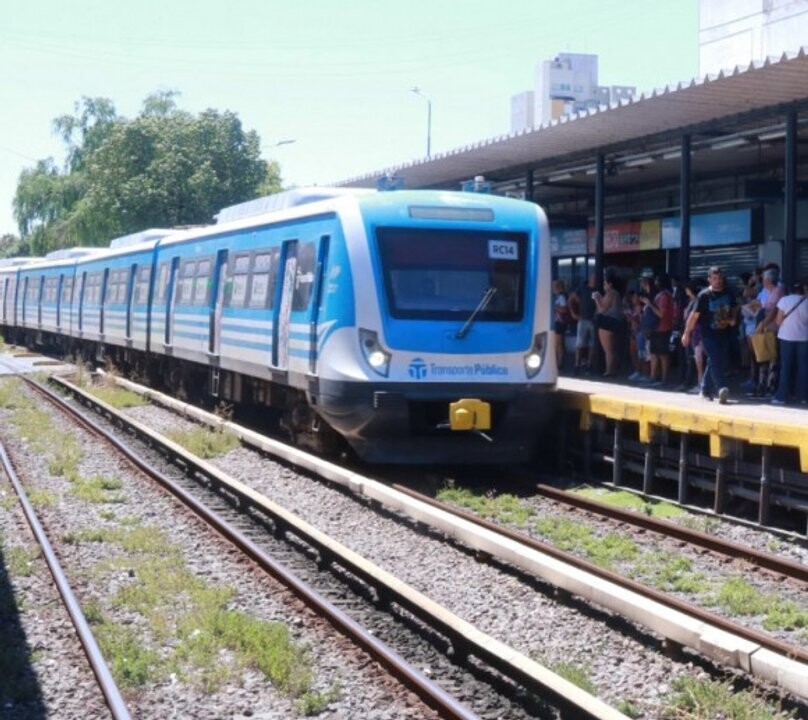
Buenos Aires, November 16 (NA) — The situation of Argentine trains is far from optimal. Last Tuesday, one of the Sarmiento line trains derailed in the Liniers neighborhood. This incident led sector workers to once again report on lack of maintenance, staff shortages, and 'poverty-level' wages.
Luckily, it was not more serious, as the train was just leaving the Liniers station and had low speed... had it been on a stretch with higher speed, we would have regretted a worse consequence,” assured Duarte. In the same vein, he stated that railway workers “always defend their workplace,” however, they also denounce those issues “that are wrong” and “document everything.” In fact, Noticias Argentinas had access to many of those images and complaints.
The driver in command of the derailed train underwent a laboratory analysis to determine his physical condition at that moment and rule out the ingestion of alcohol and/or drugs: The result was finally negative, and it was also confirmed that the incident was not a consequence of human error.
“The same workers informed Noticias Argentinas that in this case there was 'a technical problem and security failed again' and, for that reason, 'hundreds of thousands of people' who travel on the train are at risk 'constantly' and those responsible for preventing this 'do not solve the underlying problems'."
This incident adds to the complaint published by La Fraternidad, the railway workers' union led by Omar Maturano, in a communiqué published this September, the same month in which they defined several non-consecutive days, in which they reduced the speed of the trains to 30 km/h.
“This change in reality is a modern one, they are placing it now. On Tuesday, the train that derailed in Liniers was crossing a switch, but it was activated through the penultimate car and derailed,” said an employee of the Sarmiento line. “The problem we have now is that this system, which is a German system with interlocking, a fairly safe system, failed to work as it should,” he added.
Cristian Duarte, an employee of the Sarmiento railway and a member of the delegates' body, stated that they “understand the anger and little patience” of users because, ultimately, both parties “suffer from the bad service” of the trains. “Decades-old central infrastructure problems without solutions exist, but now it is aggravated by the government's chainsaw and the adjustment that falls on the railways, which ended up triggering a few days ago in a new fact, a derailment that should not have happened,” he concluded.
“They are currently below the poverty line,” he said.
«It is impossible to comply with ISO 9001 norm due to lack of homologated spare parts, especially due to a vestige and patched signaling system (English 1930; French 1980; Japanese, American, German and Chinese)».
«Thirteen years have passed and we still have underlying infrastructure problems. We have documented all defects for over 12 years and regret that in February 2012 something happened that we had been warning about and could have been avoided, such as the popularly called 'Once massacre'.»
«The most serious problem we railway workers have today, and for which the company is being devalued and is functioning poorly, is because the most important capital the company has is the human factor and workers are leaving due to the brutal drop in salaries they have had. This leads us to a great concern, in which we will have to inspect all gearboxes again to prevent this from happening again.»
«On the same Sarmiento line stretch we have signals from the 1930s (English), 1950s (French), 1970s (Japanese), and to that add German, Japanese and Chinese patches plus technologies from different generations and different origins, how is it not going to fail at some point?», indicated the Sarmiento employee.
For his part, Ruben 'Pollo' Sobrero emphasized that, in particular, in this event “it was caused by a technical defect in one of the system's switch boxes” that had been installed a week before: “It is not a human error, it is already clear,” he added.
«The problem we have now is that this system, which is a German system with interlocking, a fairly safe system, failed to work as it should,» he said.
On each of those days, the union confirmed that that decision had nothing to do with “a measure of force,” but that the decision to reduce the speed of the trains was due to the “lack of maintenance” of the tracks.
The same problem had also been the subject of a complaint by Unión Ferroviaria (UF), a dissident union from La Fraternidad, led by Ruben 'Pollo' Sobrero, who informed the Railway Operating Society, the Infrastructure Sub-management, and the Head of Signaling about the condition of the train bases and the “lack of supplies and work tools”.